Unity environment guide
Build the workflow first. Dress the kitchen second.
A medieval kitchen reads best when the player can see where food is prepared, cooked, stored, and cleaned without needing labels or exposition.
The easiest way to make a fantasy kitchen believable is to give every major object a reason to be where it is.
Start with the work sequence instead of the prop list: store ingredients, prepare them, cook them, plate them, then clean up. Your scene does not need historical simulation accuracy, but the stations should still relate to one another.
That gives you a layout that reads from gameplay distance before you add a single spoon.
Kitchen layout
Four zones are enough to make the room make sense
Keep the path simple. The player should be able to understand the room in a few seconds.
Anchor the hearth
Place the largest cooking element where it can dominate one wall without blocking circulation.
Add prep beside it
Keep the work surface close enough that the relationship between preparation and cooking is obvious.
Give storage a home
Shelves, containers, and cookware should cluster near the stations that use them.
Finish with cleaning and detail
A sink, brush, soap, bowls, and tools make the kitchen feel maintained instead of staged.
Cooking zone
Treat the hearth as equipment, not wall decoration
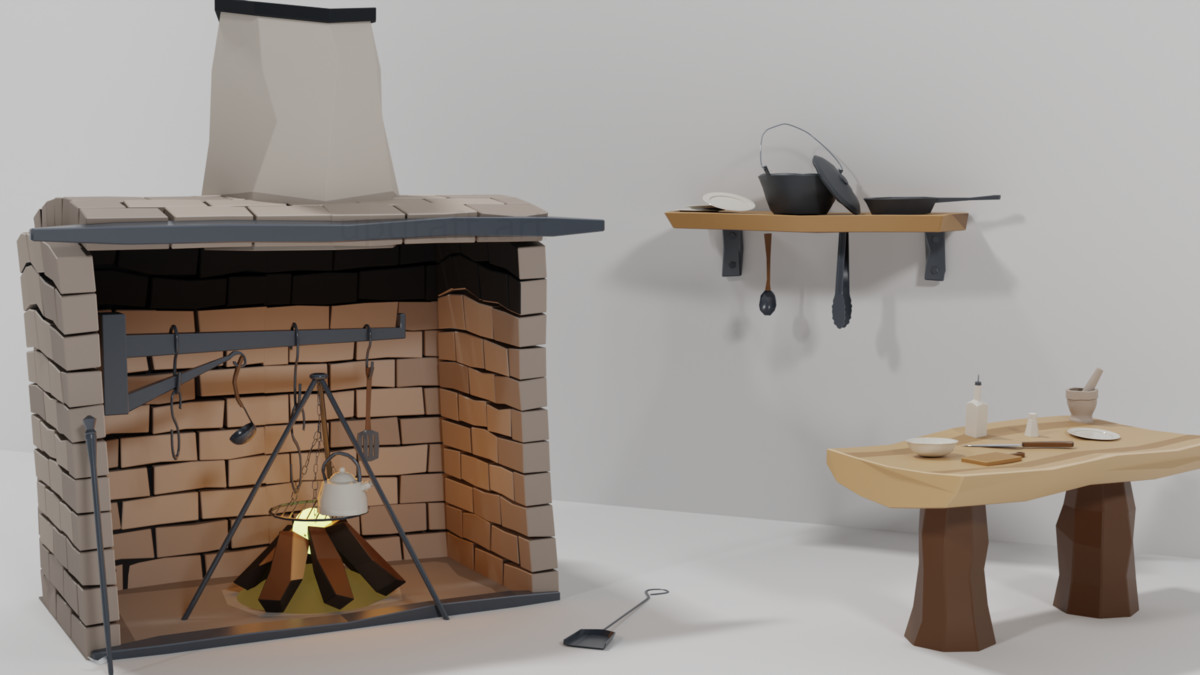
Leave enough floor space in front of the hearth for the player to read the hanging rail, grate, tripod, and tools. If you bury the station behind furniture, the most important part of the room loses its silhouette.
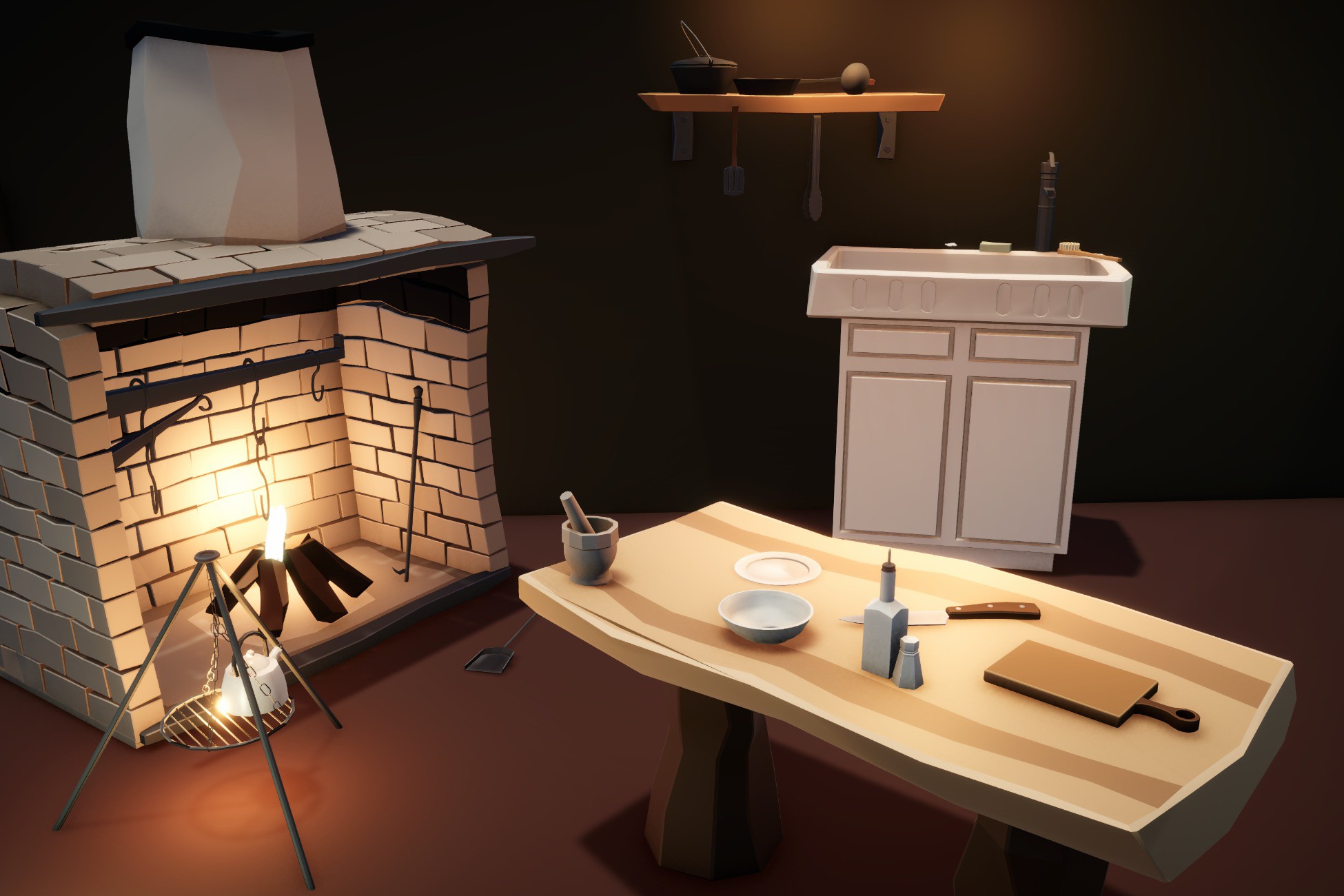
Use warm local light to pull attention toward the cooking area, then let the surrounding corners fall quieter.
A hearth becomes believable when the tools around it show how it is used.
Prep zone
Keep the prep surface visually connected to the fire
A table that sits on the opposite side of the room can still function, but it will not read as part of the same workflow unless the layout supports it. Put the prep station close enough to feel intentional, then use a shelf or containers to bridge the gap.
Prep furniture works best as part of a short visual chain from ingredients to heat.
Detail pass
Add tools where hands would actually reach for them
Keep ladles and tongs near cooking. Put a knife and board on the prep surface. Group bowls and plates where plating would happen. The exact arrangement can be stylized, but the logic should stay readable.
Small props should reinforce the stations rather than decorate every open surface.
Skip the prop-modeling stage
Stylized Medieval Kitchen Props Pack
If you want to spend your time on layout, lighting, and the game-specific details instead of building the entire kitchen vocabulary from scratch, this set covers the hearth, prep, sink, cookware, utensils, and small dressing layer.
- Stone hearth with chimney and soot interior
- Hanging rail, crane, hooks, tripod, grate, and firewood
- Sink with cabinet base and pump faucet
- Wall shelf and butcher or prep table
- Kettle, pot with lid, pan, bowls, plates, knife, and cutting board
Quick fit check
Know what you're buying
Good fit if you need
- Cozy cottage kitchens
- Tavern back rooms and food prep spaces
- Fantasy RPG interiors
- Cooking or crafting stations
- Developers who want a cohesive hearth-centered prop set
Bring your own
- A full modular room or building shell
- HDRP projects without doing your own material conversion
- Projects that require ready-made colliders on every prop
- Projects that need cooking gameplay scripts or animations included